Everyone tells parents to read to their kids. It’s on the pamphlet at the pediatrician’s office. It’s all over social media. You’ve heard it so many times it almost doesn’t mean anything anymore.
But here’s what nobody tells you: why it matters — the specific, scientific reason — changes everything about how you think about your role in your child’s reading development. And once you understand it, story time stops feeling like a nice thing to do and starts feeling like the important thing to do.
The Science of Reading Is Changing Schools — In a Good Way
Over the last decade, a movement called the Science of Reading has transformed how schools teach children to decode print. Schools are getting better and better at systematic phonics instruction — teaching children letter sounds, blending, phonological awareness. And this is a great thing. The research is solid, the results are real, and children are learning to decode earlier and more reliably than before.
But here’s something I’ve observed — first as a speech-language pathologist, then as a substitute teacher sitting inside early childhood and elementary classrooms across West Michigan, and most recently as a mom: learning to read actually has two parts. And the Science of Reading, for all its strengths, is much more focused on one than the other.
Reading Is a Two-Part Equation
This is the Simple View of Reading, a clinical framework developed by Gough & Tunmer in 1986. It’s simple and it works.
Word Recognition × Language Comprehension = Reading Comprehension
Let’s break this down.
Word recognition is decoding — the ability to look at print and translate it into spoken language. This is what phonics builds. Schools are good at this.
Language comprehension is the ability to understand spoken language — vocabulary, sentence structure, background knowledge, the ability to follow a narrative, to make inferences, to understand what words mean in context. This is what story time builds. And this is something schools cannot fully deliver — and it’s not their fault. They are doing so much, but a classroom with standards and twenty-plus students makes teaching a complex and dynamic skill like language comprehension genuinely challenging.
The creators of Story Grammar Marker, a program designed to teach narrative language, put it this way on their website: “Language comprehension is an often-overlooked factor of the Science of Reading. It happens beneath the surface and is abstract, complex, and often hidden.”
Think about what language comprehension instruction actually requires: it’s dynamic, conversational, and child-led. It’s best done in meaningful, play-based social interactions that are fun and engaging for the child (Terrell & Watson, 2018). This means stopping to talk about interesting pages, pausing to define new words, wondering out loud about the story, connecting to a character’s feelings, connecting the story to a child’s unique interests and lived experiences.
This cannot be done with twenty children at various language levels in a classroom — no matter how wonderful and well-trained the teacher is. Schools are much stronger on the first part. That second part — language comprehension — is where you come in. That is something only a family can fully provide.
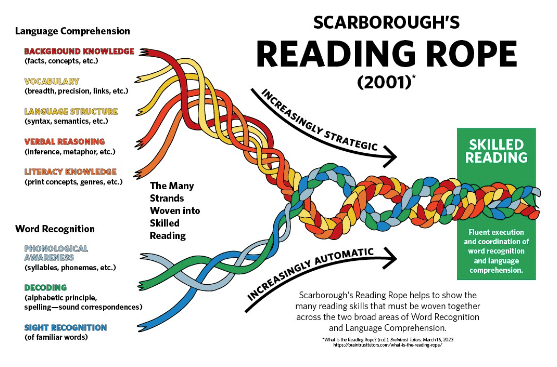
I love this image because it demonstrates how the two parts of reading influence and reinforce each other as a child learns to read — they aren’t separate tracks, they’re woven together. But look closely at the two sides. Notice how many more strands make up the language comprehension portion of the rope compared to the word recognition side. And notice the depth within each of those language comprehension strands — background knowledge, vocabulary, language structure, verbal reasoning, literacy knowledge. Each one is its own rich area of development. Word recognition is three strands. Language comprehension is five — and each of those five goes deep. That’s not an argument against phonics. It’s an argument for making sure the other half of the rope gets the attention it deserves.
I Learned This the Hard Way
When my daughter was four, I was obsessed with teaching her letters and letter sounds. Like most parents these days, I was constantly asking myself: when will she learn to read? I had letter magnets on the fridge, foam letters for the bath, alphabet books, letter puzzles — I had it all. And it was getting me absolutely nowhere. She wasn’t interested.
Around that time I was taking a continuing education course on reading instruction. I remember the speaker discussing a study in which researchers heavily emphasized reading fluency — how fast and accurately students could read. The results looked promising. Students were reading quickly and accurately. But when researchers looked more closely, the students didn’t have any idea what they were reading. The words were decoded. The meaning wasn’t there.
I remember sitting in my car after that session and feeling something shift.
She was four. She was still in the prime window for language acquisition — a sponge for vocabulary, for story structure, for the rhythms of how language works. I had been so focused on the first half of the equation that I’d neglected the second half.
So I stopped drilling letters and started reading to her for the pure pleasure of it. All kinds of books. Stories she loved, stories she chose, stories I found and chose for her because I thought she would like them. And we read them over and over again. We still read together today — she’s seven now and she can read to herself. She did learn to read in school, and now she has a love for stories.
It’s not that I ignored phonics. She got phonics at library story time, embedded in books we read together, and later at school where it belonged. I just stopped trying to do the school’s job at home and started doing mine.
Why the Window Matters
Language develops from birth — through social interactions, conversation, play, even during mundane daily activities like grocery shopping or driving in the car. All of these build language, and it accumulates long before a child ever sets foot in a kindergarten classroom.
Researchers have found that vocabulary differences between children are already significant when they start school — and those differences compound over time (Duff, Tomblin & Catts, 2015). Children who arrive at school with strong oral language foundations learn to decode more easily, partly because teachers use language to explain the abstract concepts of letter-sound correspondence — and a child who already has rich oral language can grasp those explanations (Culatta et al., 2003). They also comprehend what they read more deeply because they already have a strong knowledge base to attach new words, meanings, and concepts. This helps them make a successful transition around third and fourth grade from learning to read to reading to learn (Suggate et al., 2018, as cited in Spencer & Petersen, 2020).
That transition is where everything comes together. By fourth grade, textbooks assume fluency. Content gets complex. A child who can decode perfectly but has a small vocabulary and weak narrative will struggle academically — not because they weren’t taught phonics, but because the second half of the reading comprehension equation wasn’t built as strongly (Snow et al., 2007, as cited in Spencer & Petersen, 2020).
The good news: you have years to build it. And the primary tool is one of the simplest things a parent can do.
What Story Time Actually Does
When you read with your child — not just to them, but with them — you are building the language comprehension side of the reading equation in real time. Specifically:
Vocabulary. Books often include words that aren’t commonly used in spoken language, introducing children to words they will almost never encounter in everyday conversation or daily life (Duff, Tomblin & Catts, 2015).
Narrative structure. Characters, settings, problems, attempts, resolutions. Children who hear thousands of stories internalize this architecture. It becomes the cognitive schema they use to comprehend — and eventually write — complex text (Spencer & Petersen, 2020).
Social communication. Books introduce thinking and feeling vocabulary. These help build social schemas, improve social problem solving, and support emotion regulation (Spencer & Petersen, 2020).
Inferential thinking. “Why do you think she did that?” “What do you think is going to happen?” These questions build comprehension and executive function skills that support academics broadly (Spencer & Petersen, 2020).
Background knowledge. Every book expands what your child knows about the world. It introduces concepts and information they otherwise would not encounter in daily life.
Complex syntax. Book language is more varied and sophisticated than conversational language. Children absorb these patterns through exposure long before they can explain them (Spencer & Petersen, 2020).
The One Thing That Makes Story Time More Powerful
Research on shared reading has found something important: the conversation around the book matters as much as the book itself. Interactive reading — pausing, wondering out loud, asking questions, following your child’s lead — produces stronger and more lasting language gains than passive listening (Terrell & Watson, 2018).
This doesn’t mean drilling your child with questions the whole time. It means being curious together. It means slowing down when something is interesting to your child. It means wondering out loud and answering questions as they come up.
The goal isn’t comprehension assessment. It’s shared attention on language — which is exactly what builds comprehension.
When Story Time Isn’t Enough
For most children, a rich oral language foundation built at home — the kind this post describes — combined with good phonics instruction at school is exactly what’s needed. But some children, despite both, still struggle. They can sit through hundreds of bedtime stories and still find decoding difficult. They can have a school doing everything right and still fall behind their peers in reading fluency and accuracy. Some children have phonological processing differences that make mapping sounds to print hard — and for these kids, the brain needs more explicit, systematic, and repeated instruction than a school can provide within their day. This is where a speech-language pathologist comes in. SLPs are trained in the phonological processing skills that underlie decoding as well as the language skills that drive comprehension — and when a child is struggling despite good instruction at home and at school, that’s worth a conversation with an SLP.
Your Role Is Irreplaceable
Schools are doing their job. Phonics instruction, decoding, phonological awareness — the Science of Reading has made schools measurably better at the word recognition side of the equation. That is real and it matters.
But reading comprehension is a two-part equation, and the second part — the language comprehension side — is built in living rooms and bedrooms and car rides and library trips. It’s built in the ten minutes before bed with a book to end your day together. It’s built in the conversation that happens when you pause to talk about the story.
That’s not supplementing what school does. That’s doing something school cannot do.
We all know we’re supposed to read to our kids. Now you know why — and you know that what you’re building during story time is not just something fun to do. It’s half of reading itself.
In upcoming posts, I’ll be writing about how narrative language develops across childhood, what to listen for in your child’s storytelling, how to choose the right books for your child’s language level, and how to bring language learning into everyday life. Because there’s a real difference between reading to your child and reading with them — and that difference is something every parent can learn.
Nickora Carmichael is a speech-language pathologist (M.S., CCC-SLP) and the founder of Sunflower Speech Haven, a pediatric mobile speech therapy practice serving Grand Haven, Spring Lake, Holland, Muskegon, and surrounding West Michigan communities. She has practiced in school and private practice settings.
References
Culatta, B., Kovarsky, D., Theadore, G., Franklin, A., & Timler, G. (2003). Quantitative and qualitative documentation of early literacy instruction. American Journal of Speech-Language Pathology, 12, 172–188.
Duff, D., Tomblin, J. B., & Catts, H. (2015). The influence of reading on vocabulary growth: A case for a Matthew effect. Journal of Speech, Language, and Hearing Research, 58, 853–864.
Gough, P. B., & Tunmer, W. E. (1986). Decoding, reading, and reading disability. Remedial and Special Education, 7(1), 6–10.
Scarborough, H. S. (2001). Connecting early language and literacy to later reading (dis)abilities: Evidence, theory, and practice. In S. B. Neuman & D. K. Dickinson (Eds.), Handbook of early literacy research (pp. 97–110). Guilford Press.
Spencer, T. D., & Petersen, D. B. (2020). Narrative intervention: Principles to practice. Language, Speech, and Hearing Services in Schools, 51, 1081–1096.
Stanovich, K. E. (1986). Matthew effects in reading. Reading Research Quarterly, 21(4), 360–407.
Story Grammar Marker / Mindwing Concepts. (n.d.). Language comprehension and the Science of Reading. Retrieved from mindwingconcepts.com
Terrell, P., & Watson, M. (2018). Laying a firm foundation: Embedding evidence-based emergent literacy practices into early intervention and preschool environments. Language, Speech, and Hearing Services in Schools, 49, 148–164.